


GuidanceIf you want to translate into another language, please use the translate feature in your browser.
Definition of Horology
Horology comes from the Greek hora (time) and logos (study), meaning the study of time and its instruments. In modern practice, horology encompasses the study, design, and making of timepieces — from ancient sundials to modern mechanical watches, and even atomic clocks that define global precision today.
The History of Horology: From Sunlight to Mechanisms
- Ancient Civilizations: Egyptians and Babylonians used sundials and obelisks to track shadows.
- Middle Ages: The first mechanical clocks appeared in European church towers, powered by weights and gears.
- 17th Century: Christiaan Huygens’ invention of the pendulum revolutionized accuracy.
- 18th–19th Century: Pocket watches and later wristwatches became both practical tools and symbols of status.
- 20th Century: The quartz revolution (1969) introduced high accuracy at low cost, shaking the mechanical watch industry.
- Today: Mechanical watches endure not for accuracy, but for artistry, tradition, and philosophy.
Mechanical vs Quartz Watches
| Aspect | Mechanical Watch | Quartz Watch |
|---|---|---|
| Power Source | Mainspring (manual/automatic) | Battery |
| Accuracy | Seconds per day | Seconds per month |
| Maintenance | Requires servicing, winding | Minimal |
| Artistic Value | High: complex movement, hand-finishing | Low, functional |
| Emotional Value | Tradition, heirloom potential | Practical, mass-produced |

Types of Watches in Horology
- Dress Watch (Elegant & Minimalist): Thin, simple, refined — perfect for formal occasions.
- Diver Watch (Durable & Functional): Water-resistant, rotating bezel, built for underwater exploration.
- Pilot Watch (Aviation-Inspired): Large dial, legible numerals, often with GMT functions.
- Field Watch (Military & Utilitarian): Rugged, reliable, easy to read in harsh conditions.
- Complication Watch (High Technical Mastery): Features such as perpetual calendars, moonphases, chronographs, or tourbillons.
Each type is not only about function, but also about history, culture, and lifestyle.
The Beauty of the Movement: The Beating Heart
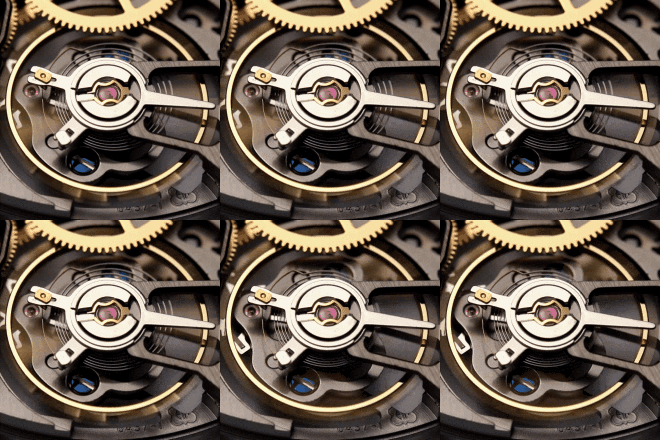
For enthusiasts, the movement is the soul of a mechanical watch.
- Mechanical Harmony: Hundreds of tiny gears, springs, and escapements working in perfect rhythm.
- Visual Aesthetics: Finishes like Côtes de Genève and perlage elevate the movement into art.
- Transparency: Sapphire casebacks reveal the mesmerizing “dance” of gears and rotors.
- Intimate Ritual: Winding a crown or feeling the rotor spin creates a personal bond between wearer and watch.
Watching a movement in action is like witnessing a miniature orchestra that never stops playing.
Why People Love Mechanical Watches
Despite quartz being more accurate and practical, mechanical watches remain beloved because:
- Heritage & Tradition: They embody centuries of human ingenuity.
- Art & Craftsmanship: Each movement is a handmade masterpiece.
- Emotion & Identity: Often passed down through generations, carrying family stories.
- Life Philosophy: They teach patience, respect for limitations, and appreciation of every second.
The Philosophy of Time in Horology
Horology is not just about measuring time, but about understanding its meaning.
- Patience: Mechanical watches require care and winding.
- Limitation: Power reserves remind us that our own energy is finite.
- Interconnection: Small gears sustain the whole, just as individuals sustain society.
- Eternity in Finitude: Watches outlive their owners, carrying memories across generations.
A Fictional-Philosophical Narrative: The Inherited Watch
Arka received an old mechanical watch from his grandfather. The case was scratched, the leather strap cracked, but when he wound the crown, a soft ticking emerged — tick… tick… tick…
At first, Arka thought it was just an antique. But as he wore it, he began to feel the watch speaking. Each beat reminded him of his grandfather’s stories: struggle, patience, and love that endured through time.
In the rush of modern life, the watch became a reminder that time is not just numbers on a digital screen, but a living pulse.
Closing Reflection
Horology is a window into time — not only technically, but also emotionally and philosophically. From its long history, the contrast between mechanical and quartz, to the symbolic meaning of movements and heirlooms, horology teaches us that time is art, not just numbers.
“A mechanical watch does not merely count time — it teaches us how to live within it.”
